You know liquidity. You know fair value gaps, market structure, displacement. You’ve mapped Goldbach Levels, you understand time, you’ve watched more hours of trading content than you can count.
And still — when the chart is live, the entry feels like a guess.
I know that feeling very well, because I lived in it for years. I started trading in 2012. For most of that time, my answer to confusion was to learn more. Another concept, another model, another video. It never worked, and it took me embarrassingly long to understand why.
The problem was never missing knowledge. The problem was that my knowledge was disconnected.
The elephant in the room
Knowing the concepts is not the same as knowing how to trade them.
Every concept you’ve collected is valuable. But a concept on its own doesn’t tell you when it matters. So you see a liquidity sweep and take it as an entry — in the middle of nowhere. You see a clean 1-minute setup and take it — against the higher-timeframe direction. You flip your bias three times in one session, because every new candle activates a different concept in your head.
That’s not a knowledge problem. Ten more concepts make it worse, not better.
What finally changed my trading was not a new concept. It was giving every concept I already had a job — a fixed place in a sequence, so each one answers exactly one question and nothing more.
What a process actually is
My process is one chain, and the order is the whole point:
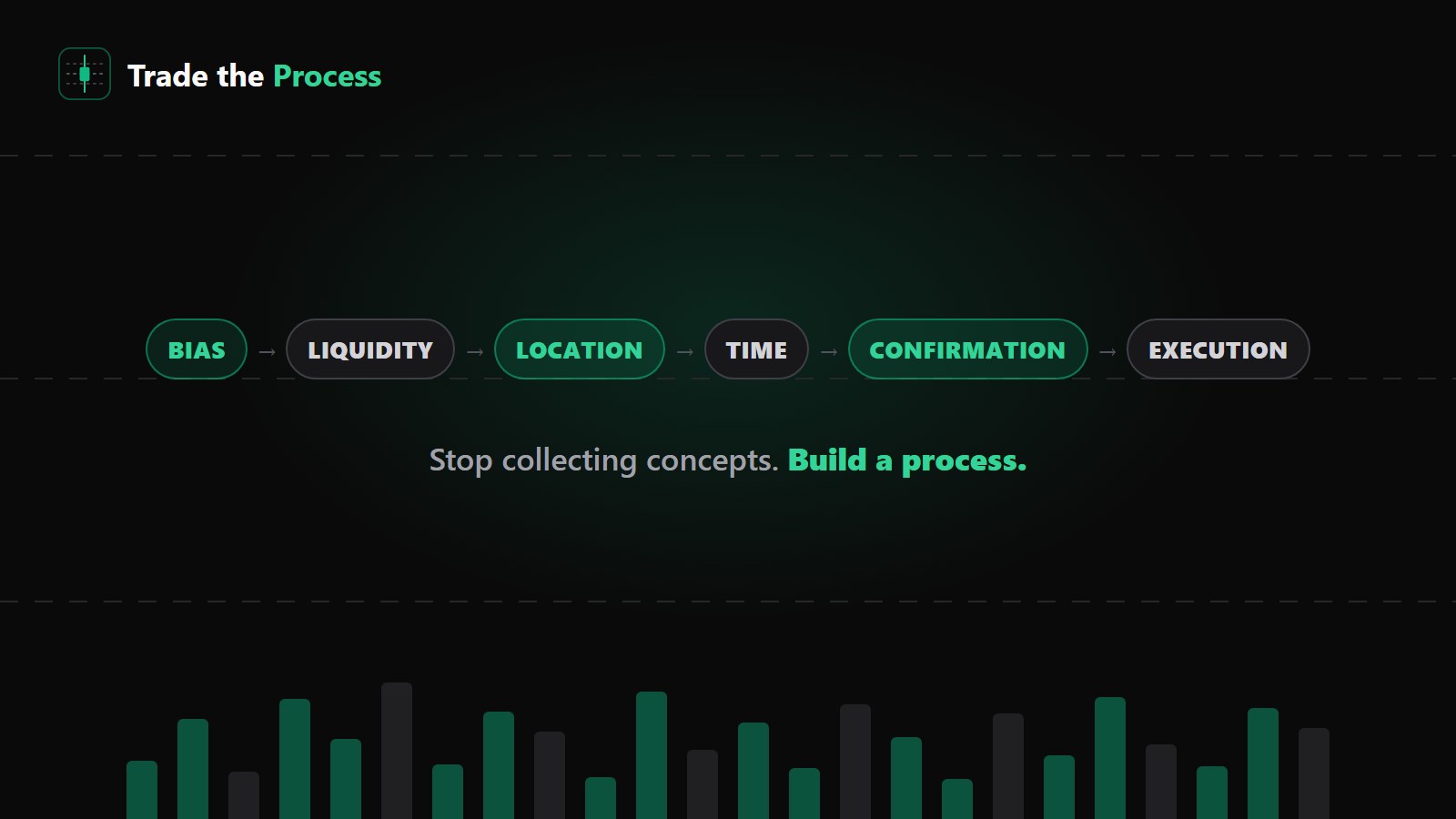
Bias → Liquidity → Location → Time → Confirmation → Execution
Bias — what is the higher-timeframe story, and which direction do I prefer? (Weekly and daily first. Always.)
Liquidity — where is price likely being drawn to? This defines realistic targets before I ever think about entries.
Location — has price reached an area where participating even makes sense? A confirmation in the middle of nowhere is not enough.
Time — is this happening in a window where meaningful moves actually develop?
Confirmation — has price given me evidence, at the right location, in the right window?
Execution — only now: entry, invalidation, risk, target. The entry model is the last step of the decision, not the whole strategy.
A lower-timeframe signal is never allowed to override an unclear or contradictory higher-timeframe story. That single rule removed most of my bad trades.
The goal is not to react to everything. The goal is to know exactly what you are waiting for.
What I will NOT teach — let me be very clear
Because I’m turning this process into a video course, I owe you total clarity about what’s inside and what is not.
I will not teach Goldbach Time (GBT) or Algo Path following with time. That is AJ’s work. He created it, he teaches it, and he teaches it with a precision I’m not going to imitate. GBT is part of my own confirmation step — but if you want to learn it, learn it from the source: AJ’s mentorship. Not from me. I’ll say this in the course too, every time it comes up.
I will not teach you “new” concepts. Nothing in my process is my invention. ICT concepts, Goldbach Levels, Algo Path, liquidity, market structure — all of it already exists, created and taught by others. What’s mine is the connection: the process that decides when each concept matters, and a couple of models I developed from that process. That’s what the course is — no rebranding, no secret new indicator, no “concept nobody knows.”
Who this course is for — and who it’s not for
This course assumes you already know ICT concepts, Goldbach Levels, and Goldbach Time. I build directly on that foundation. If those words don’t mean anything to you yet, this course is not for you — start with the original sources first.
This is not a course for beginners. And it’s not a mentorship, not a signal service, and not a Discord to hang out in. It’s a focused video course for traders who have the pieces and are missing the structure.
What I WILL teach
Goldbach Levels and how I map them into a directional roadmap.
Algo Path following — the price side, aligned with higher-timeframe bias.
The most profitable ICT concepts, explained in my own words, with the exact role each one plays in my process.
How everything connects into one repeatable decision — and how I built trading models out of it, including the models I trade myself.
And most importantly: how to take this structure and build a process that fits you — your timeframes, your pace, your personality. My process is the example. Yours is the outcome.
While I build the course
I’m recording it now. If you want to follow along, the waitlist gets free educational market analysis, chart breakdowns, and early access when it launches.
You may already know enough concepts. Now build a process that tells you how to use them.
— Salim
Everything on this site is educational content, not financial advice. Trading involves substantial risk.